Stand up after a long drive or a full day at a desk and the front of your hips can feel locked. The first few steps are short, you lean slightly forward, and straightening up takes more effort than it should. If you run, lift, play pickup games or garden on weekends, that stiffness follows you into the thing you actually want to enjoy.
We’re not doctors or physical therapists. This post is a plain-language explanation of why long sitting tends to leave the hips feeling this way, plus a simple routine built on two ideas: move your hips through their range often, and stretch with your glutes switched on so the stretch registers. If you are looking for how to fix tight hip flexors from sitting, this is the approach we would start with.
How sitting all day leaves your hips feeling shortened and stiff
When you sit, your hips are bent, usually somewhere near 90 degrees. The muscles on the front of the hip, the hip flexors, sit close together in that position for hours. The main ones are the psoas and iliacus, which run from your lower spine and pelvis to the top of your thigh, and the rectus femoris, one of your quadriceps, which crosses both the hip and the knee.
Muscles tend to adapt to the positions they spend the most time in. If your hips are bent for eight hours, then stood on for a few minutes, then bent again in the car, the front of the hip gets very little time at full length. Standing up asks those muscles to lengthen quickly, and they feel short and resistant.
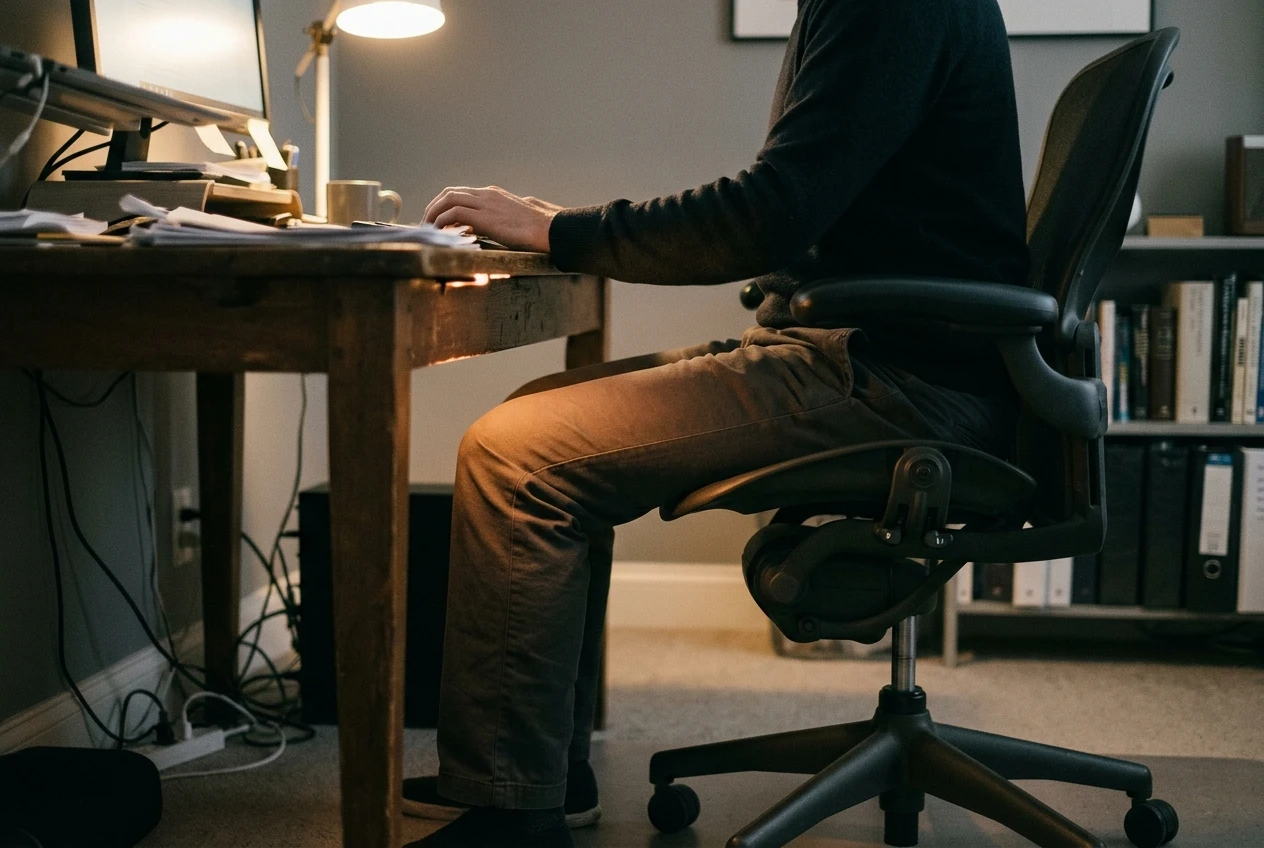
Sitting also switches off the muscles at the back of the hip. Your glutes do very little in a chair, because the chair supports you. Hip flexors and glutes work as opposites around the hip joint, so when one group is always short and the other is rarely used, the pelvis can tip forward and the lower back can arch more than usual when you stand. That pattern is a common reason people feel tightness at the front of the hips and a dull ache in the lower back at the same time.
The result is that “tight” often describes two things at once: muscles that have spent a long time in a shortened position, and muscles on the other side of the joint that are not doing their share. A good routine addresses both.
Is it really your hip flexors? Signs worth noticing (and when to see a professional)
Tight hip flexors usually show up in a few recognizable ways:
- A pulling feeling at the front of the hip or top of the thigh when you stand up after sitting.
- Difficulty taking a long stride or feeling your back leg “stuck” behind you when walking or running.
- Your lower back arching noticeably when you stand or lie flat on your back.
- Stiffness that eases after a few minutes of walking around.
A simple check is to lie on your back at the edge of a bed or sturdy bench, pull one knee to your chest, and let the other leg hang off the edge. If the hanging thigh cannot rest roughly level with the surface, or the knee straightens out, the front of that hip may be limited. This is a rough self-check, not a diagnosis.
Some symptoms point away from simple stiffness, and a doctor or physical therapist is the right person to ask about them:
- Sharp or pinching pain at the front of the hip, especially when you bend it.
- Numbness, tingling or pain that travels down the leg.
- Stiffness that does not ease with movement, or that gets worse over weeks.
- Pain that started after a fall, a collision or a sudden pull.
- Clicking or catching in the joint that comes with pain.
Stretching an area that is painful for a different reason can make things worse, so it is worth getting that checked first.
The half-kneeling hip flexor stretch, and the small tweak that makes it work
The half-kneeling stretch is the most common hip flexor stretch, and most people feel nothing from it, or feel it in the lower back. The fix is a small pelvic adjustment.
Here is how to set it up:
- Kneel on one knee with a folded towel or mat under it. Place the other foot flat in front, with the front knee roughly over the ankle.
- Keep your torso upright and your ribs stacked over your hips.
- Tuck your pelvis under, as if you were bringing your belt buckle toward your chin. This is a posterior pelvic tilt.
- Squeeze the glute of the kneeling leg, the one on the side you are stretching.
- While holding that squeeze, shift forward a small amount, a couple of inches at most.
You should feel a stretch at the front of the hip on the kneeling side, near the crease of the hip and into the upper thigh. If you let your lower back arch instead of tucking the pelvis, the stretch moves into your spine and the hip flexor barely lengthens. A small tuck and a small shift do more than a deep lunge.
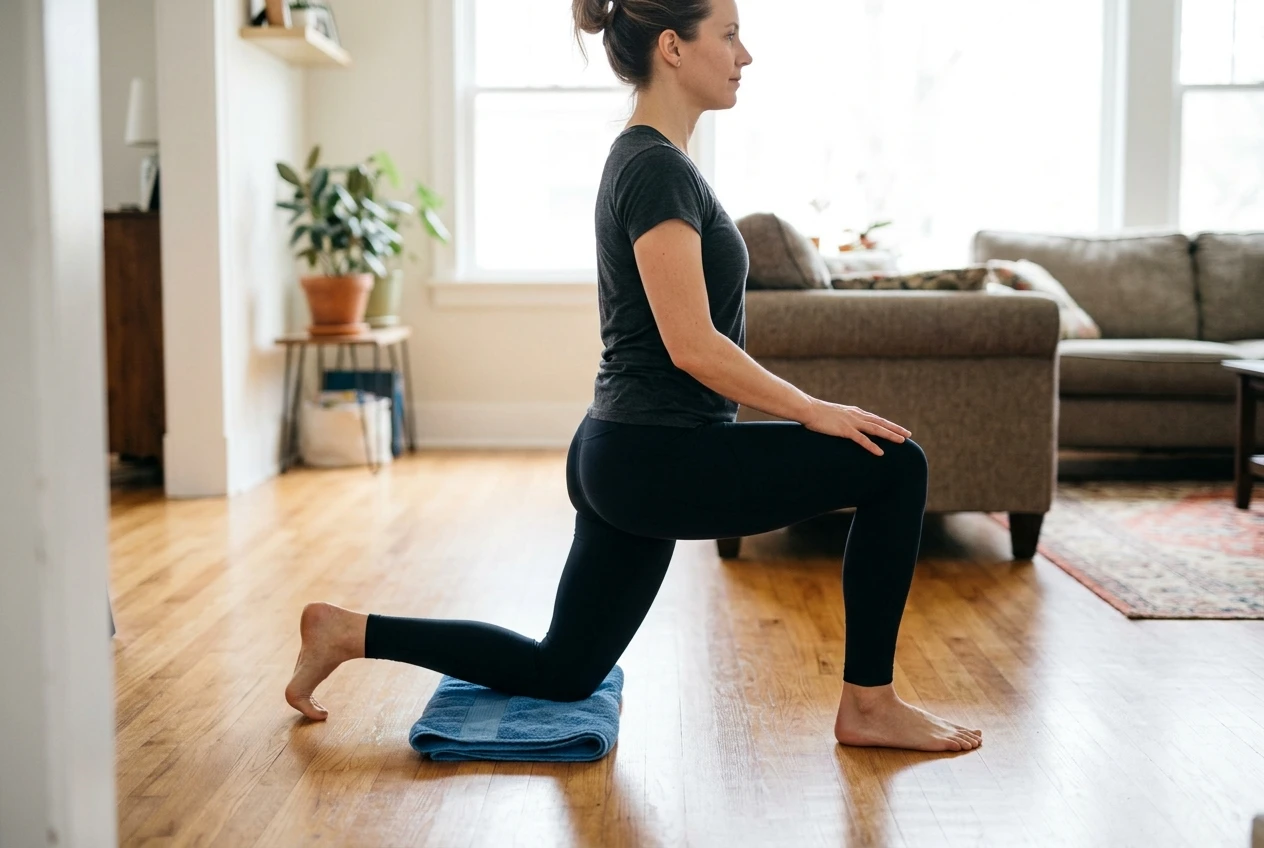
Hold for 30 to 45 seconds and breathe slowly. Do two rounds per side. If the stretch is gone after a few seconds, you have probably lost the tuck, so reset it.
Two more hip openers: the couch stretch and the standing lunge reach
Once the half-kneeling position makes sense, two variations add something different.
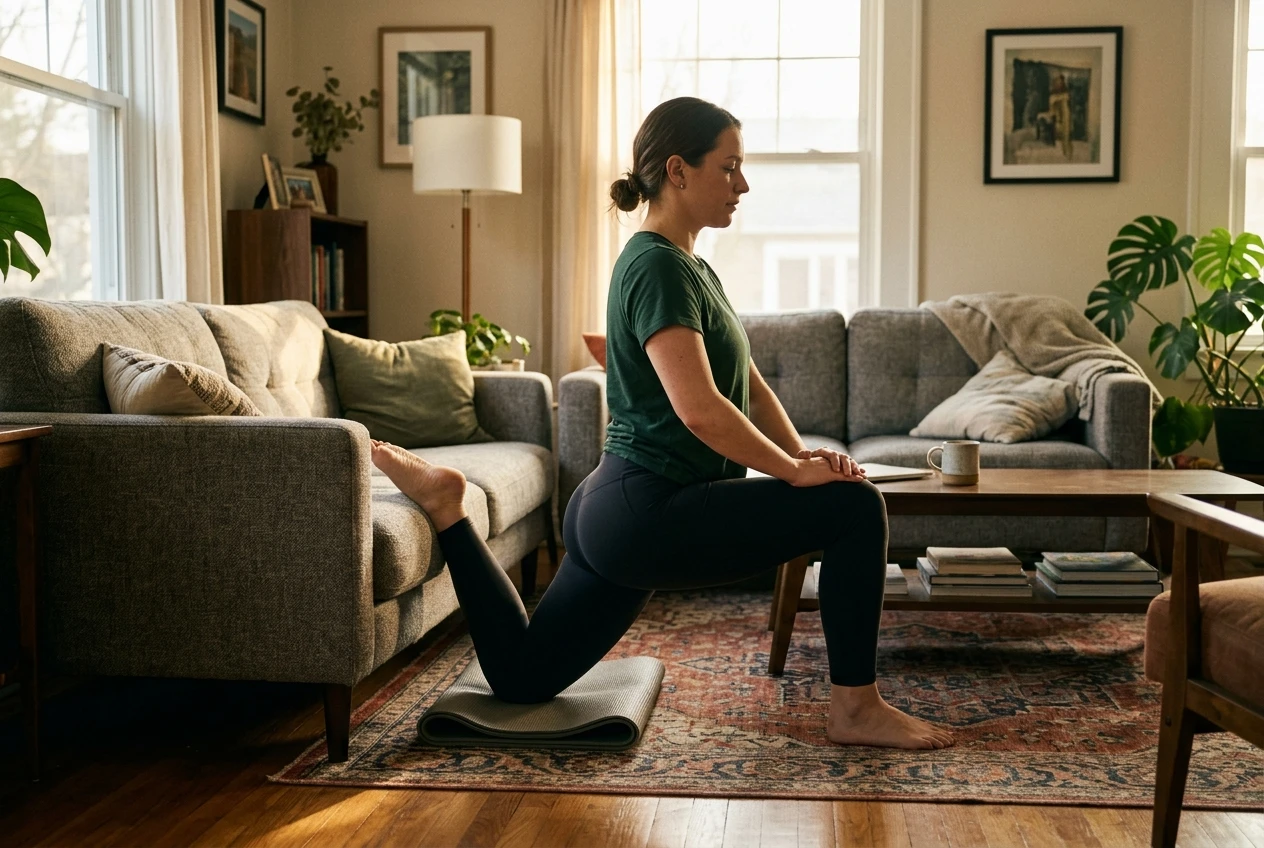
The couch stretch
This one stretches the rectus femoris as well as the hip flexors, because the knee is bent at the same time. Kneel facing away from a couch or wall. Place one knee on the floor close to the base, and rest the shin and foot of that leg up the couch or wall. Step the other foot forward into a lunge, then rise until your torso is upright.
As with the half-kneeling stretch, tuck the pelvis and squeeze the glute of the back leg. This stretch is intense for many people. If it is too much, move the knee farther from the wall so the back shin is less steep, or keep your back foot on the floor and skip the wall altogether. Hold 30 to 60 seconds per side.
The standing lunge reach
This is the easiest to fit in anywhere, because you need no floor. Step one foot back into a short lunge stance. Tuck the pelvis, squeeze the back glute, and reach the arm on the back leg’s side overhead. Then lean gently away from the back leg, toward the side of your front foot.
You should feel a long line of stretch from the hip up through the side of the torso. Move in and out slowly for five repetitions per side, or hold the reach for 20 to 30 seconds. It works well in a hallway, next to the car or between meetings.
Waking up your glutes so the stretch holds
Many people stretch their hip flexors, feel looser for a few minutes, and are back to normal by the time they have sat down again. One reason is that the stretch changes length but not how the muscles around the hip share the work. If the glutes stay quiet, the pelvis returns to its tipped position.
Short glute activation before or after stretching gives the stretch something to hold onto. Two simple options:
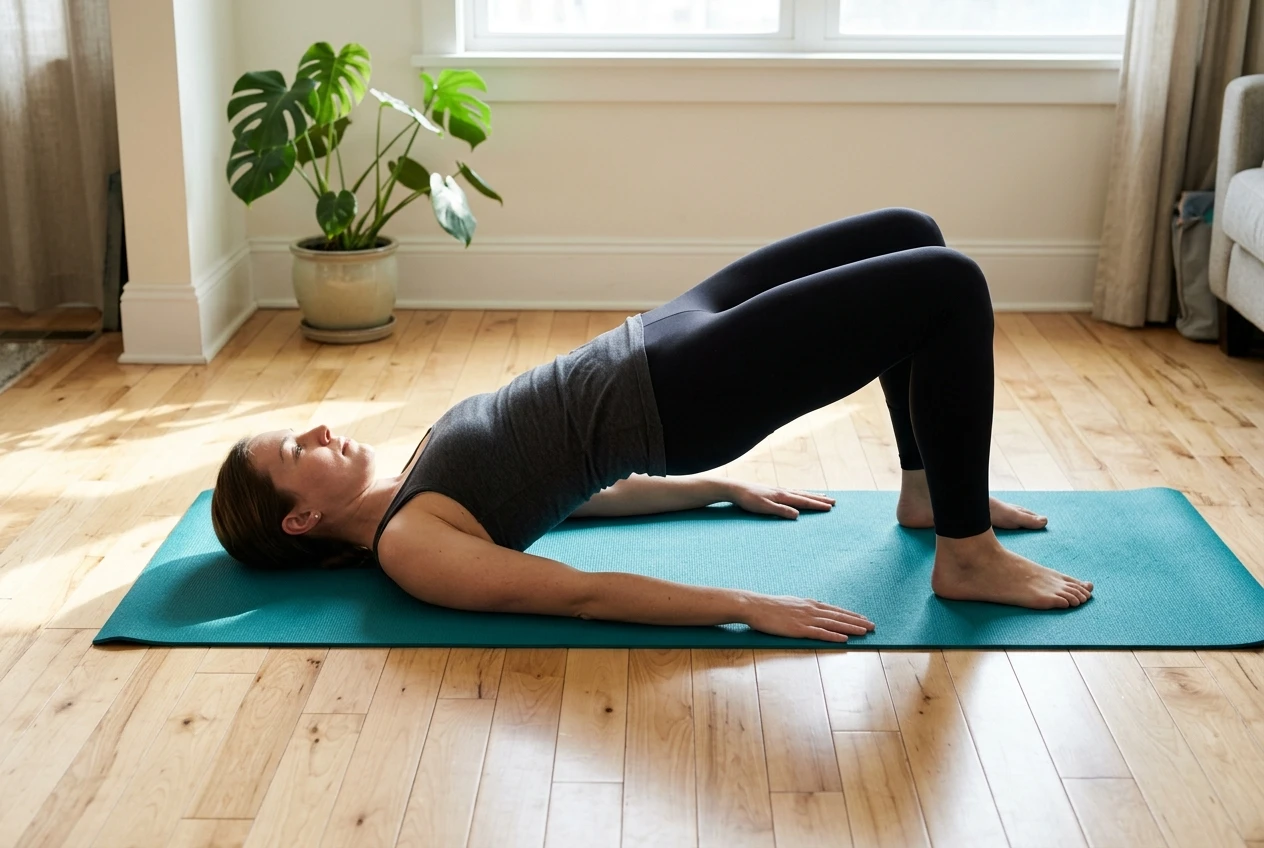
- Glute bridge. Lie on your back with knees bent and feet flat. Press through your heels, lift your hips until your body forms a straight line from shoulders to knees, and squeeze your glutes at the top for a second. Lower slowly. Do 10 repetitions. If you feel it mostly in your hamstrings or lower back, move your feet slightly closer to your hips and think about tucking your tailbone as you lift.
- Standing glute squeeze. Stand tall, squeeze both glutes hard for five seconds, then release. This is a quick reset you can do in a queue or at a desk.
Squeezing the glute during the stretches themselves, as described above, adds to this. When the back-leg glute is on, it helps keep the pelvis tucked, and the hip flexor on the same side is lengthened more directly.
Break up your sitting: tiny movement breaks that take under a minute
Stretching for 10 minutes after work helps, but it leaves the other eight hours alone. Moving your hips through their range several times during the day gives the front of the hip regular time at full length, so it has less to catch up on.
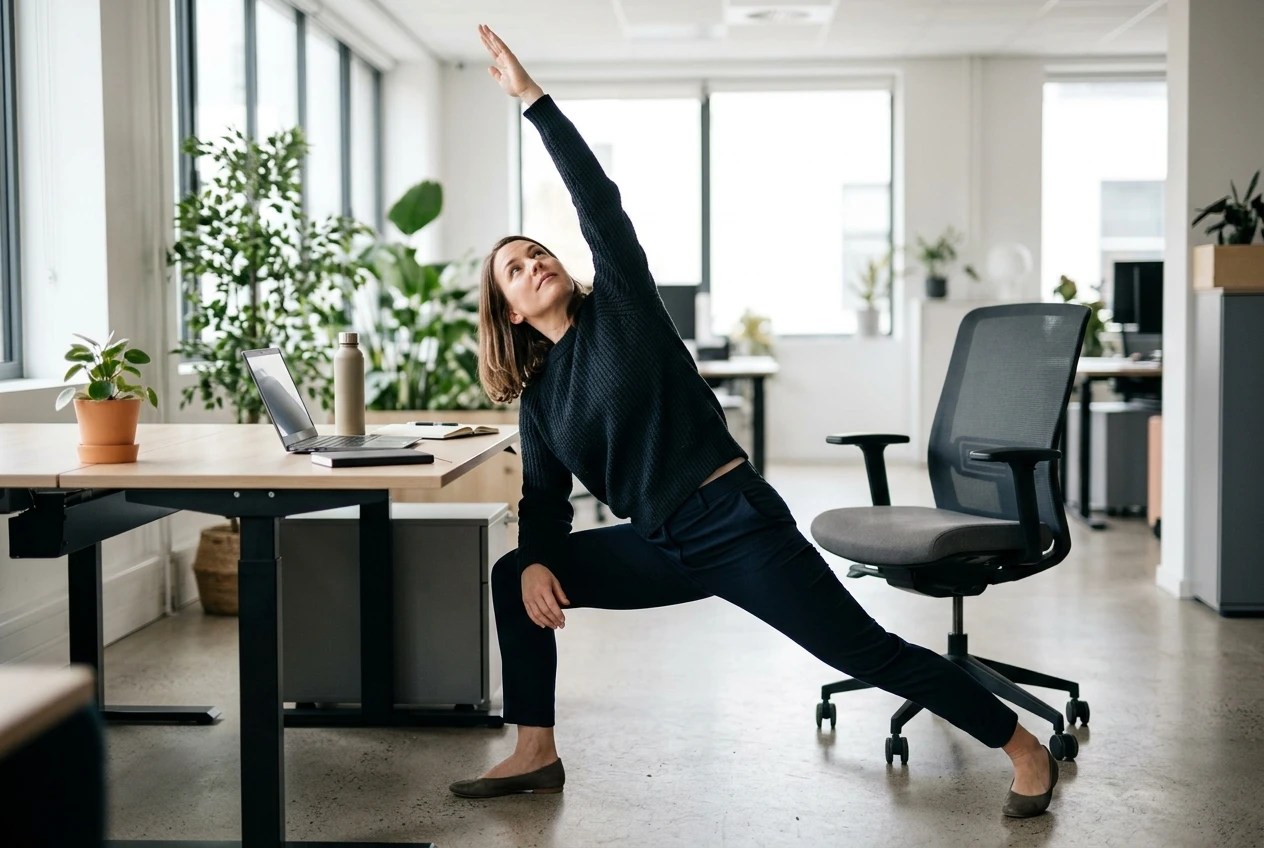
Set a timer at an interval that suits your day, such as every 30 to 45 minutes, and pick one of these:
- Stand up and walk to refill a water bottle or to the far bathroom.
- Do five standing lunge reaches per side.
- Stand and march in place with high knees for 20 seconds.
- Stand, squeeze your glutes, and gently push your hips forward for a few breaths.
- Take phone calls standing or walking when you can.
On car trips, stop when you can and walk for a couple of minutes. These breaks do not need to be vigorous. The point is variety: your hips spend a few seconds extended instead of bent. For another desk-day reset aimed at the upper body, our piece on shoulder drills to undo a day of hunching over a keyboard pairs well with these.
A 10-minute routine you can do after work or before a workout
This sequence puts the pieces in order: movement first, glute activation next, then stretching while the glutes are awake. Use it after work or as a warm-up before a run, lift or game.
- Walk and hip circles (1 minute). Walk around, then stand and draw slow circles with each knee, as large as is comfortable.
- Glute bridges (2 minutes). Two sets of 10, squeezing at the top.
- Half-kneeling stretch (3 minutes). Two rounds of 30 to 45 seconds per side, with the pelvic tuck and glute squeeze.
- Couch stretch (2 minutes). One round of 45 to 60 seconds per side, using the easier version if needed.
- Standing lunge reach (2 minutes). Five slow repetitions per side, finishing with a short hold.
Move at a pace where you can breathe normally. The stretches should feel strong but never sharp. If you are using this before a workout, keep the holds toward the shorter end and follow it with your normal warm-up. Doing the routine a few times a week and adding the daily movement breaks tends to matter more than one long session. If you want more options, our list of essential mobility exercises to improve your range of motion covers other joints.
Mistakes that keep hips tight
A few habits make hip stretching less effective.
Overstretching. Pushing into a sharp or burning stretch tends to make the muscle guard against it. Aim for a firm, steady pull that you could hold while talking.
Arching the low back. The most common error. If your ribs flare and your lower back curves, the stretch is happening in your spine. Tuck the pelvis, keep your ribs down, and shorten the range if you need to.
Rushing. A 10-second stretch gives the muscle little time to respond. Holds of 30 seconds or more, with slow breathing, work better than quick repetitions.
Stretching without activating anything. Stretching alone can feel good and fade quickly. Pair it with glute work, as in the routine above.
Skipping the smaller breaks. If you stretch for 10 minutes and then sit motionless for the next five hours, the front of the hips spends most of the day shortened again. Regular short movement counts.
Treating both sides the same. Many people find one hip tighter than the other. Spend a little longer on the stiffer side, and notice whether it changes over a few weeks.
For more on building these habits into the rest of your day, see our post on daily habits to preserve your range of motion.
Join the RegainYourRange email list to get our free printable hip and desk-day mobility routine, plus new posts from what we’re learning about moving with ease.