
Hours at a keyboard add up in a specific way: shoulders roll forward, the upper back rounds, and the chest muscles shorten while the muscles between your shoulder blades sit stretched out and weak. Your body isn’t just tired at the end of the day, it’s stuck in a shape. That shape makes a golf swing feel short, a tennis serve feel stiff, and even reaching for something on a high shelf feel like a small negotiation with your own joints.
This article lays out five shoulder mobility exercises for desk workers, ordered to build on each other, that you can do in work clothes without any equipment. Total time is about five minutes. None of it requires a gym, a mat, or even standing up from your chair for most of it.
Why desk posture tightens your shoulders more than you think
When you sit at a keyboard, your arms sit in front of your body for hours at a stretch. That position shortens the pec muscles across your chest and lets your shoulder blades drift forward and apart. The muscles in your upper back that are supposed to hold your shoulder blades in place get stretched thin and stop doing their job well.
This isn’t just a posture complaint, it changes how your shoulder joint actually moves. The ball of your shoulder sits in a shallow socket, and where your shoulder blade sits determines how much room that ball has to rotate. When your shoulder blade is pulled forward and down all day, the joint loses some of its ability to rotate overhead and behind your back. That’s the tightness you feel when you reach into the back seat of a car, or when your throwing arm or swing feels shorter than it used to.
The fix isn’t a single stretch. It’s a short sequence that opens the front of the shoulder, re-activates the muscles behind it, and restores rotation in both directions. The five drills below do that in order.
Drill 1: Doorway pec stretch to open a rounded chest
Stand in a doorway and place your forearm on the frame, elbow bent to roughly 90 degrees, upper arm out to the side at about shoulder height. Step through the doorway with the leg on the same side until you feel a stretch across the front of your chest and shoulder. Hold for 20 to 30 seconds, then switch sides.
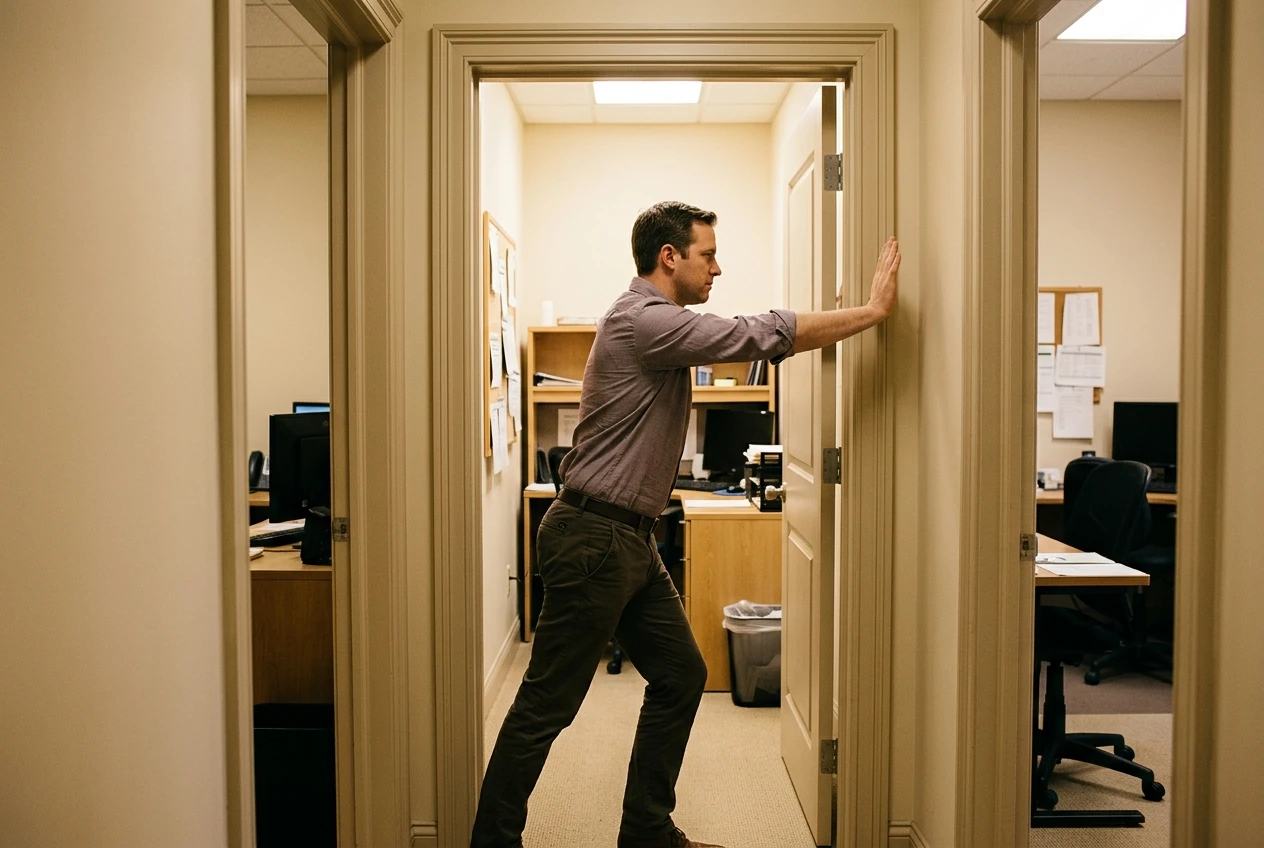
Repeat with your arm raised slightly higher on the frame, then slightly lower, to hit different fibers of the pec muscle. Three positions per side, about 20 seconds each, is enough to feel the front of your shoulder open up before you move to the next drill.
Drill 2: Wall slides to wake up your shoulder blades
Stand with your back against a wall, feet a few inches out from it, and press your lower back, upper back, and head against the wall. Raise your arms to shoulder height with elbows bent, forearms against the wall, like a goalpost shape. Slowly slide your arms up overhead, keeping as much contact with the wall as you can, then slide them back down.
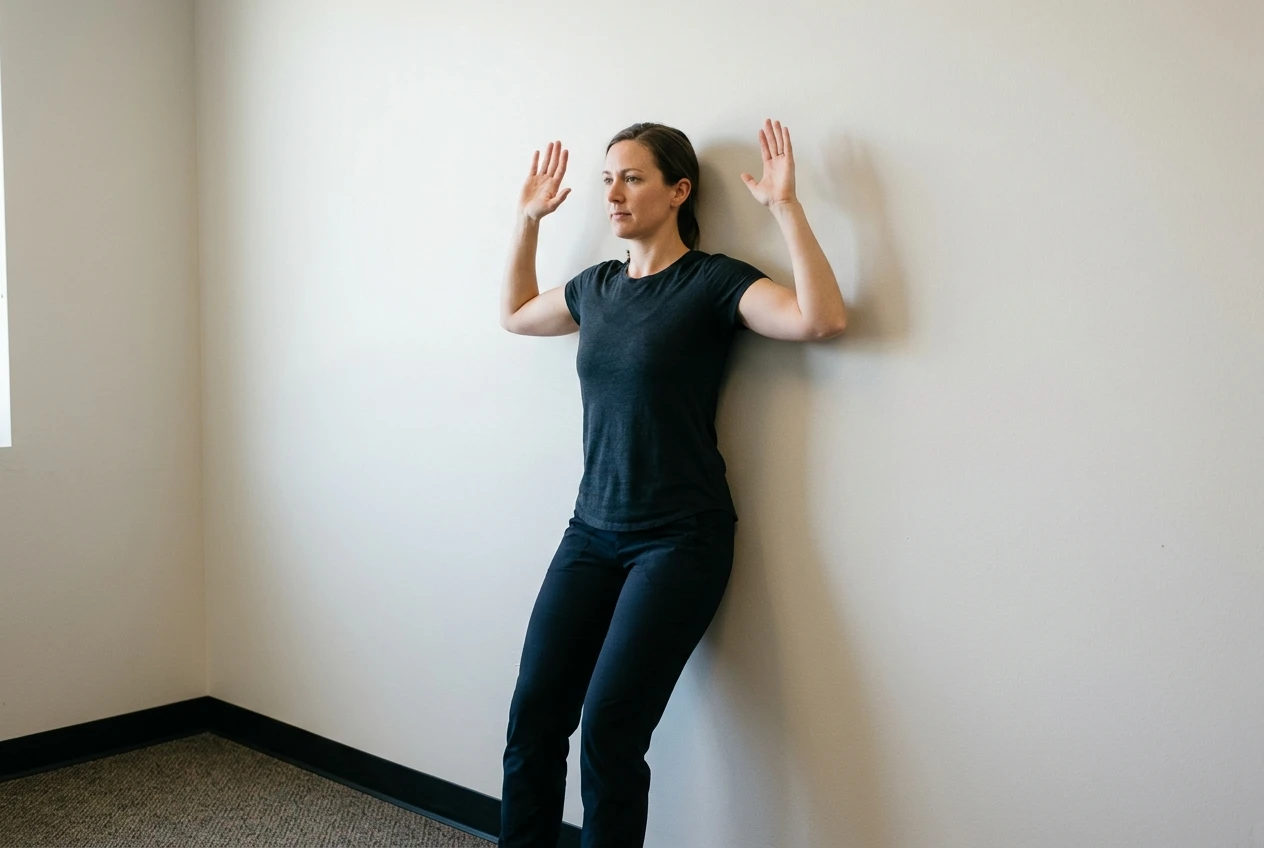
Most desk workers find their elbows or forearms peel off the wall somewhere around ear height. That’s the point where your shoulder blades stop moving well, usually because the muscles between them have gone quiet. Do 10 slow reps, focusing on keeping contact rather than how high you can reach. This drill directly reverses the forward-shoulder position a keyboard puts you in.
Drill 3: Arm circles and band pull-aparts for the back of the shoulder
Stand up and make large, slow circles with both arms, 10 forward and 10 backward, keeping them as wide as you comfortably can. This warms up the joint and gets blood moving through the muscles around it.
If you keep a resistance band at your desk, follow the circles with 15 band pull-aparts: hold the band with both hands at chest height, arms extended, and pull it apart until your arms are out to your sides, squeezing your shoulder blades together. No band on hand works too. Instead, do 15 reps of pulling your elbows back and squeezing your shoulder blades together, arms bent at your sides, like you’re starting a rowing motion. Either version targets the rear shoulder and upper back muscles that spend the day stretched and inactive.
Drill 4: Thread the needle for thoracic rotation
Get down on your hands and knees, or do a standing version if you’re at your desk and not on the floor. On hands and knees, slide one arm underneath your body, palm up, rotating your upper back until your shoulder and ear rest near the floor. Then reverse the motion, threading that same arm up and out to the ceiling, following it with your eyes, opening your chest as far as it will go.
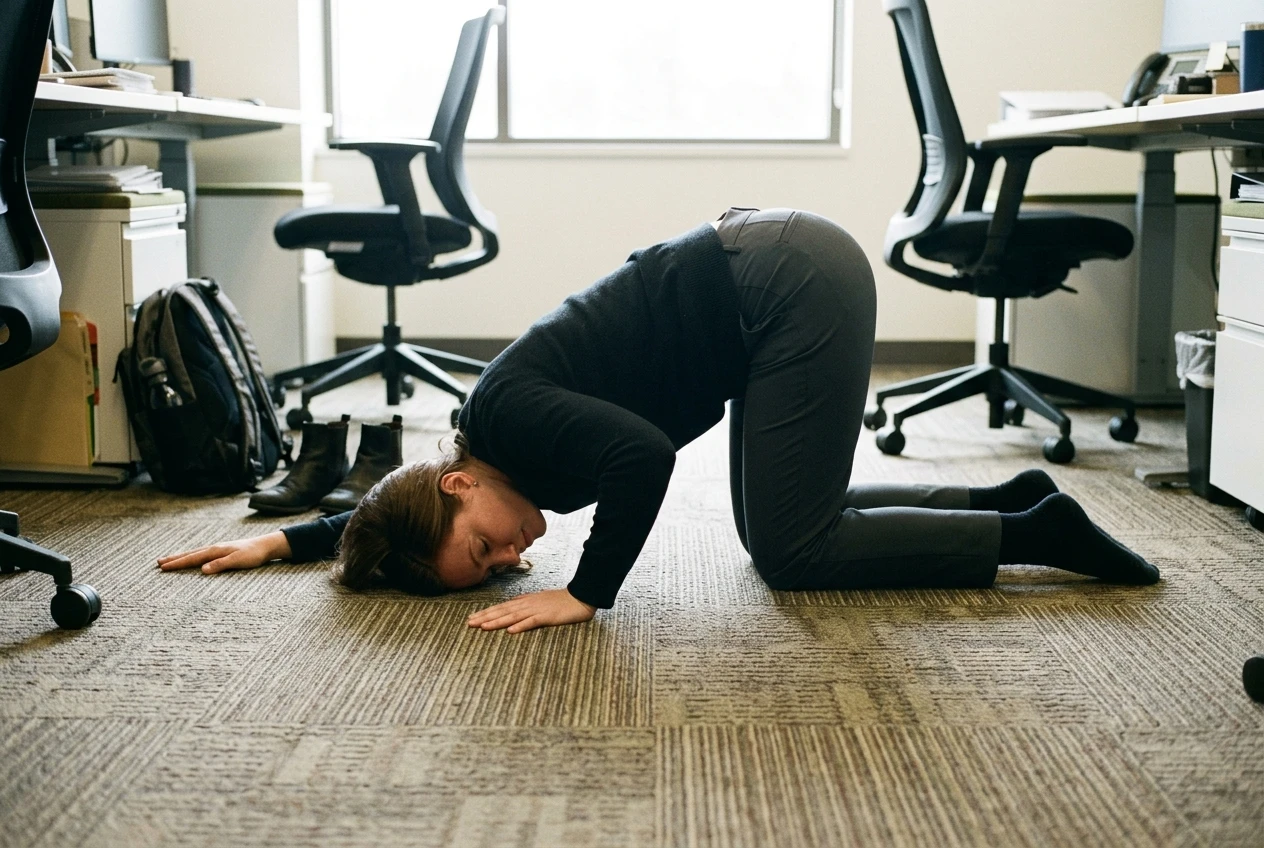
Do 8 to 10 slow reps per side. This drill isn’t just for your shoulder, it’s for the thoracic spine, the middle section of your back that rounds forward when you sit. A stiff thoracic spine forces your shoulder to compensate for rotation it should be sharing with your upper back, which is part of why shoulder tightness and upper back tightness tend to show up together.
Drill 5: Sleeper stretch to free up internal rotation
Lie on your side, the tight shoulder on the bottom, arm bent to 90 degrees in front of you, palm facing down. Use your other hand to gently press your forearm down toward the floor until you feel a stretch in the back of the bottom shoulder. Hold for 20 to 30 seconds, then switch sides.

This one targets internal rotation specifically, a range that desk posture tends to tighten along with the external rotation most people associate with “tight shoulders.” If lying on the floor isn’t practical mid-workday, the same motion works seated: bend your arm in front of you at 90 degrees and use your opposite hand to press it gently toward your body, feeling the stretch in the back of the shoulder rather than the front.
Building a 5 minute shoulder reset into your workday
The order matters less than the consistency. Running through all five drills once, mid-morning or mid-afternoon, takes about five minutes and interrupts the hours your shoulders would otherwise spend locked in the same forward position.
A few ways to make it stick:
- Set a recurring reminder for the same time each day, so it becomes part of your schedule rather than something you have to remember.
- Keep a resistance band in your desk drawer so drill 3 never depends on finding equipment.
- Pair the reset with something you already do, like a coffee refill or a call where you don’t need to be at your screen.
- Do the doorway stretch and wall slides even on days you don’t have time for all five. Partial is better than skipped.
The goal isn’t to add another task to your day. It’s to spend five minutes undoing what the other eight hours did to your shoulders.
Keeping the rest of your body loose too
Shoulders rarely tighten up alone when you sit most of the day. Hips, hamstrings, and your lower back tend to follow the same pattern, shortening in the positions a chair puts them in and stiffening everywhere else. A shoulder reset handles one piece of a bigger picture.
Pair this with the daily mobility habits in Daily Habits To Preserve Your Range Of Motion to keep the tightness from coming back.